Concern
For the months you have been finding more hair on the pillow than the comb. For the part line that has slowly widened. For the new mother, the man at the temple recession, the woman watching her ponytail thin — hair loss is a quiet anxiety that most people carry alone for too long before they ask anyone. The Hairmical range is built around the actives that the dermatology and trichology literature considers most defensible for visible shedding: Procapil's three-mechanism complex, caffeine for follicular microcirculation, biotinyl-tripeptide for follicle anchoring. Topical actives work on the follicle's clock — give them a hundred days before judging.
Last reviewed by BIOSAR Scientific Team, PharmD, Cosmetic Chemistry, Pharmacy practice on .
Epidemiology
Hair loss is among the most prevalent dermatological complaints in adults. Androgenetic alopecia — the patterned, genetically driven form — affects approximately 50% of men by age 50 and 40% of women by age 70 (Source: Hamilton, Ann N Y Acad Sci 1951; Sinclair, J Investig Dermatol Symp Proc 2007). Telogen effluvium, the diffuse, stress-triggered form, accounts for an additional 30%+ of acute shedding episodes and surged measurably in the post-COVID literature, with surveys reporting incidence rates two to three times pre-pandemic baselines (Source: Bin Saif et al., Int J Trichology 2011; Mubki et al., J Am Acad Dermatol 2014). In hard-water regions, high mineral content and frequent heat styling raise the incidence of mechanical breakage, while postpartum effluvium remains under-reported because the shedding phase peaks two to four months after delivery — long after most women have stopped consulting their obstetrician for skin or hair changes.
Why it happens
Patterned thinning is genetically inherited and mediated by dihydrotestosterone. Susceptible follicles miniaturise progressively under DHT signalling, producing finer, shorter hairs each cycle. Procapil and caffeine target this pathway through reduced 5-alpha-reductase activity and improved follicle anchoring.
Postpartum, perimenopause, thyroid dysfunction, and oral contraceptive transitions all shift the androgen and oestrogen balance that governs follicle cycling. The result is acute or chronic shedding that is fully reversible once hormonal balance restores. Diagnosis requires bloodwork — TSH, ferritin, vitamin D.
Iron, vitamin D, zinc, biotin, and protein deficiency each impair anagen elongation. Iron deficiency is the single most common reversible cause of diffuse shedding in women. Ferritin below 30 ng/mL consistently associates with telogen effluvium even when haemoglobin is normal.
Sustained psychological stress, surgery, severe infection, or rapid weight loss can push 30%+ of anagen follicles into early telogen. Shedding peaks two to four months after the event and recovers within six to twelve months once the trigger resolves.
Mechanism
Hair loss is rarely a single-cause condition. The follicle is a miniature organ that cycles through growth, regression, rest, and shedding phases on its own clock. When that clock is disrupted — by hormones, nutrition, inflammation, or mechanical stress — the result is visible thinning. Each mechanism below has a published trichology pathway and is addressable with the right topical strategy.
Every scalp follicle moves through four phases. Anagen is active growth and lasts two to seven years; this phase determines maximum hair length and accounts for roughly 85% of follicles at any given time. Catagen is a brief two-to-three-week regression where the follicle base contracts. Telogen is a three-to-four-month resting phase, occupying about 10–15% of follicles. Exogen is the active shedding phase: the old hair releases as a new anagen hair pushes up beneath it. The healthy scalp loses 50–100 hairs per day as a normal part of this cycle.
Pathological shedding occurs when one of three things happens. First, the proportion of follicles in telogen rises sharply — this is telogen effluvium, where a triggering event (illness, surgery, weight loss, postpartum hormone shift) pushes anagen follicles into telogen prematurely. Three to four months later, those follicles enter exogen all at once and the patient notices handfuls of hair in the shower. Second, anagen duration shortens progressively, so each new hair grows shorter and finer than the last — this is the miniaturisation seen in androgenetic alopecia. Third, the follicle is mechanically damaged or the hair shaft itself breaks before reaching exogen — traction alopecia and chemical-process breakage. Knowing which pattern is at work is the first step in any meaningful intervention.
Androgenetic alopecia is the genetically inherited, hormone-mediated thinning that produces classic male pattern (frontal recession plus vertex thinning) and female pattern (diffuse central thinning preserving the frontal hairline). The mechanism centres on dihydrotestosterone, or DHT — the more potent metabolite of testosterone, produced locally in the scalp by the enzyme 5-alpha-reductase. DHT binds to androgen receptors on susceptible follicles and triggers progressive miniaturisation: each new growth cycle produces a shorter, finer, less pigmented hair until the follicle eventually goes dormant.
Susceptibility is genetic and is inherited polygenically — not from a single Y-chromosome locus, despite the persistent myth. The androgen receptor density on scalp follicles, the activity of local 5-alpha-reductase, and the threshold at which the follicle responds to DHT all vary by family. This is why oral 5-alpha-reductase inhibitors (finasteride, dutasteride) and topical anti-androgens slow but rarely reverse the process — they reduce the DHT signal, but the underlying receptor sensitivity remains. Procapil, an in-vitro proven combination of biotinyl-tripeptide, oleanolic acid, and apigenin, targets the same pathway through three mechanisms: improved peri-follicular microcirculation, reduced 5-alpha-reductase activity, and strengthened follicle anchoring at the dermal papilla. Caffeine acts as a complementary mild 5-alpha-reductase inhibitor with documented penetration to the follicle bed.
Telogen effluvium is the diffuse, reactive form of hair loss. It is not patterned and does not produce miniaturisation — instead, anagen follicles are pushed prematurely into telogen by a systemic trigger. Common triggers include high fever, surgery under general anaesthesia, rapid weight loss (more than 5 kg in two months), iron deficiency, vitamin D deficiency, thyroid dysfunction, postpartum hormone fluctuation, and severe psychological stress sustained for weeks or months.
The shedding peaks two to four months after the trigger, which is why the cause is so often missed in clinic. By the time the patient presents with handfuls of hair, the original event has receded from memory. The good news is that telogen effluvium is reversible: once the trigger resolves, follicles re-enter anagen on their normal schedule and full density typically returns within six to twelve months. The intervention window is limited to supporting the scalp environment and the new anagen hairs as they emerge — that means biotin, zinc, and amino acid support, gentle cleansing, and avoiding compounding stressors like aggressive heat styling. For postpartum effluvium specifically, the typical course runs two to six months and resolves spontaneously in roughly 90% of cases.

Pharmacist's note
When patients ask why they are still shedding three months in, the honest answer is patience. Topical actives work on the follicle's clock, not ours — visible improvement on Procapil, caffeine, or biotinyl-tripeptide takes three to six months because that is how long a new anagen cycle requires to reach the scalp surface. We tell pharmacy customers to commit to a full hundred-day routine before judging results.
From the BIOSAR ranges
The science
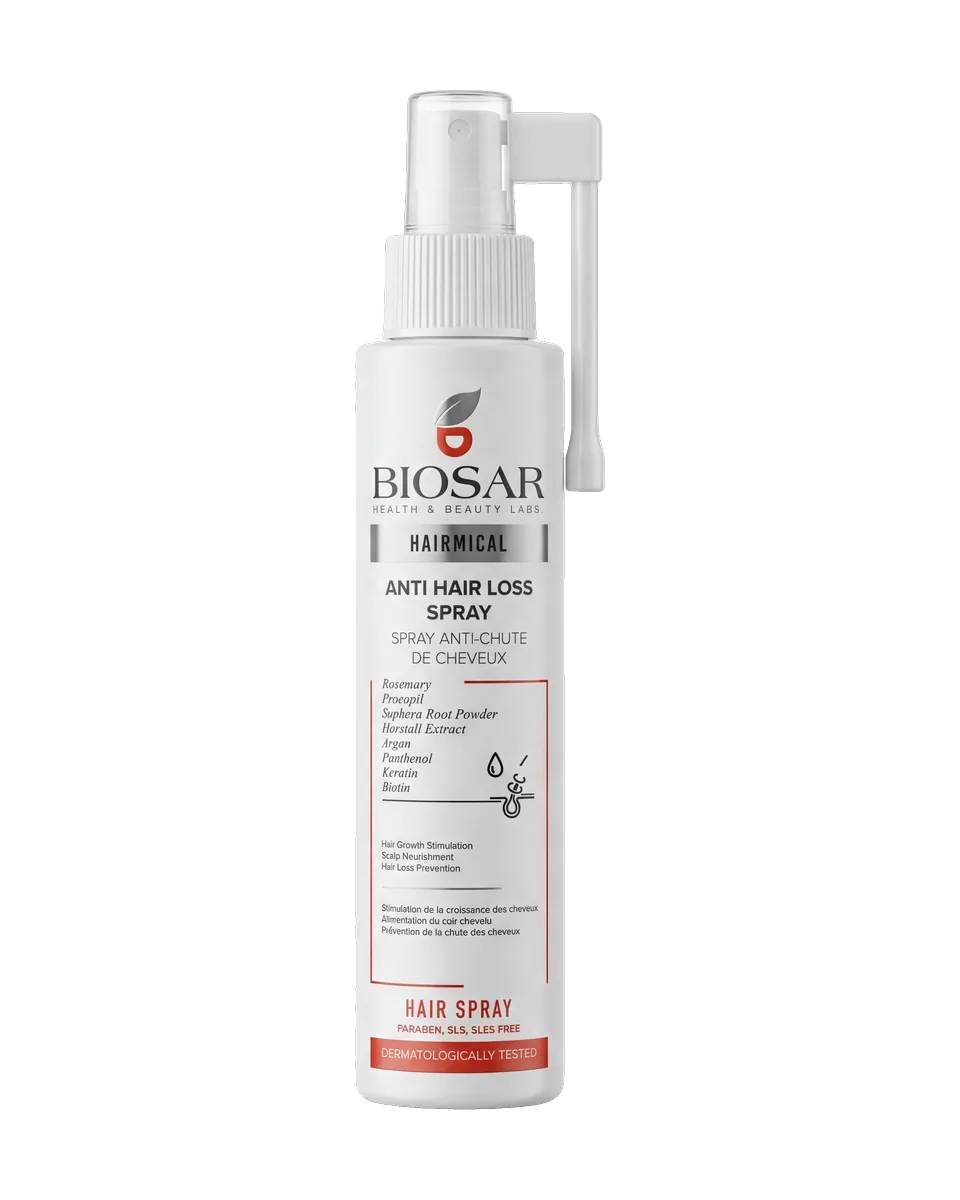
Visible thinning traces back to a shortening follicular cycle and weaker root anchoring. Hairmical works on that clock together: Procapil's biotinyl-GHK, apigenin and oleanolic acid complex reinforces anchoring, Caffeine energizes the scalp, and Keratin with Biotin support strand structure across two to six months of steady use.
Related conditions
Losing fifty to one hundred hairs per day is considered normal. Visible thinning at the part line, receding temples, or clumps in the drain after washing suggests accelerated shedding worth addressing.
Topical peptide complexes like Procapil support the existing follicle cycle and may reduce further thinning. They do not regenerate dormant follicles. For advanced loss, consult a dermatologist about additional options.
Where to look next
Seborrheic dermatitis, folliculitis, and psoriasis impair the peri-follicular environment and accelerate shedding. Treating the inflammatory component — with ketoconazole, zinc pyrithione, or salicylic acid — is a prerequisite for any anti-loss strategy. Healthy scalp first, then follicle support.
Tight ponytails, braids, extensions, and aggressive heat styling produce traction alopecia at the hair line and breakage along the shaft. The damage is mechanical, not metabolic, but distinguishing it from true follicle loss matters because the corrective action is entirely different — and reversible.
A Procapil-based shampoo is a foundation but works best combined with a leave-on serum or spray. Scalp contact time during a wash is short; leave-on formats extend active delivery through the day.
Yes. Telogen effluvium pushes a wave of hairs into the shedding phase two to three months after the trigger. Active shedding typically resolves in about six months. Full cosmetic regrowth may take twelve to eighteen months.